



Waves of Destruction
This submission is currently being researched & evaluated!
You can help confirm this entry by contributing facts, media, and other evidence of notability and mutation.
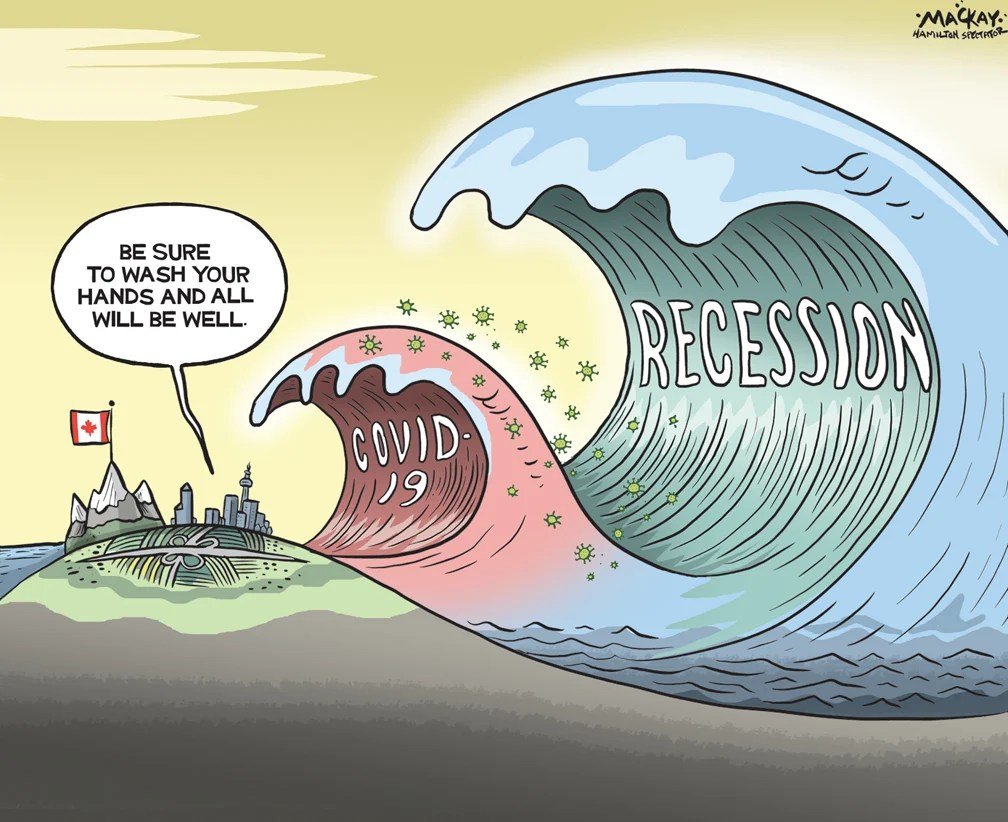
Waves of Destruction (also known as “Waves of Annihilation”) is a viral editorial cartoon and exploitable meme format depicting a coastal city facing multiple incoming tsunami waves, each labeled with escalating global crises. The meme is typically used to illustrate compounding systemic threats and the tendency of institutions or the public to focus on smaller, immediate problems while ignoring larger, existential dangers.
Origin
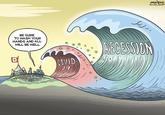
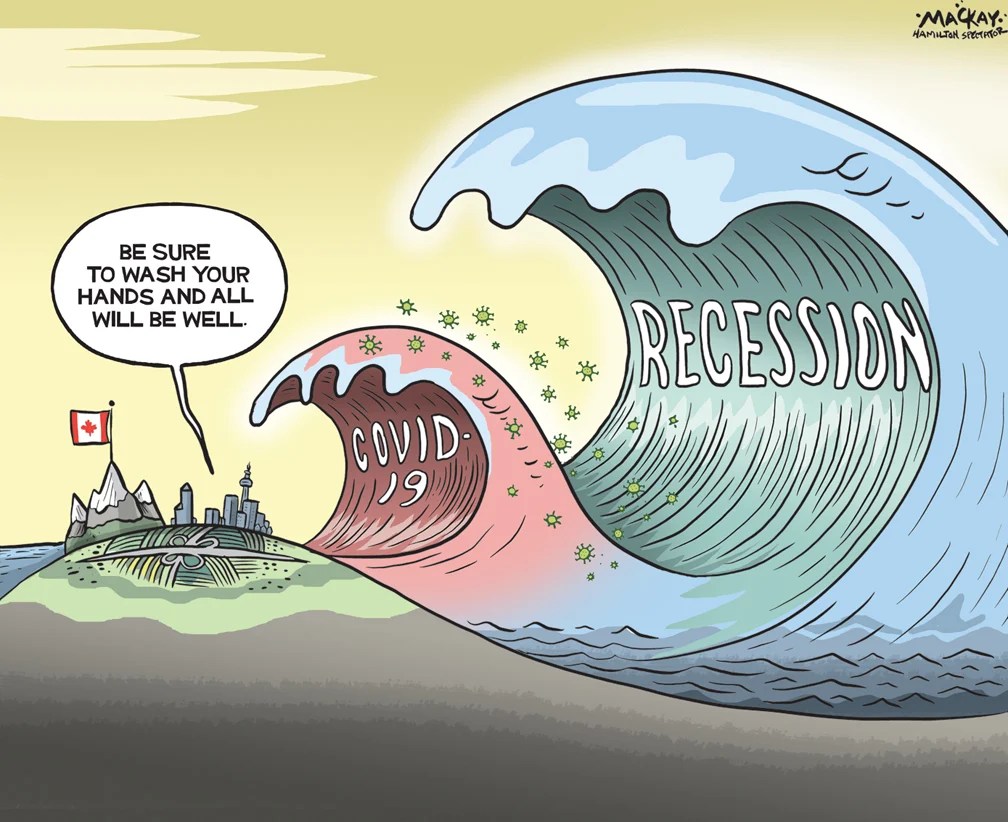
The original cartoon was created by Canadian editorial cartoonist Graeme MacKay and first published on March 11, 2020, the same day the World Health Organization declared COVID-19 a global pandemic.
The initial version featured two large waves approaching a city:
- “Coronavirus”
- “Recession”
In the foreground, officials reassured the public with messaging such as “be sure to wash your hands and all will be well,” highlighting a disconnect between official advice and the scale of the unfolding crisis.
Premise
Each version of the meme follows a consistent visual structure:
- A city or population center in the foreground
- A small, immediate concern being addressed by authorities (often framed as inadequate or superficial)
- A series of massive tsunami waves approaching from the background
- Each wave represents a major crisis, typically arranged so that:
- The waves increase in size
- The threats become more severe or long-term
The format emphasizes:
- Escalation of crises
- Systemic risk and interconnected problems
- Misplaced priorities or false sense of security
Evolution
Shortly after publication, the cartoon spread widely online and began to be modified and expanded by users.
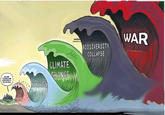
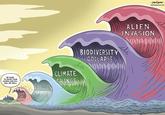
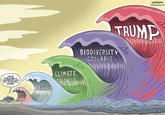
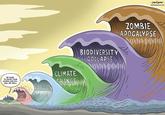
Common additions included new waves such as:
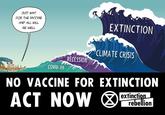
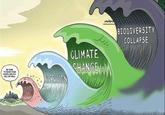
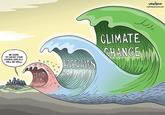
- Climate change
- Biodiversity collapse
- Political instability
- War
- Inflation or economic crises
Later versions--both official and unofficial--often feature three, four, or more waves, continuing the pattern of “one more, bigger threat.”
MacKay himself updated the cartoon multiple times, incorporating new waves to reflect emerging global concerns.
Spread and Memeification
The image became one of the most widely shared editorial cartoons of the COVID-19 era, appearing across:
- Social media platforms
- News articles and academic publications
- Activist campaigns and protest banners
Users frequently:
- Translated the labels into different languages
- Replaced wave labels with region-specific issues
- Added additional waves to fit new narratives
This led to the format becoming a template meme, often circulated without attribution and adapted for various political or social messages.
Usage
The meme is commonly used to express:
- “The current crisis is only the beginning”
- “Bigger problems are being ignored”
- Criticism of short-term thinking or inadequate policy responses
- Doomer or fatalistic perspectives on global issues
It is often applied in discussions about:
- Climate change
- Economic instability
- Public health
- Long-term systemic risks
Themes
Key recurring themes include:
- Escalation: Each wave is larger and more destructive than the last
- Inevitability: The waves are unstoppable, suggesting impending disaster
- Complacency: Authorities focus on minor or symbolic actions
- Distraction vs. reality: The foreground problem contrasts with the larger threats
Notable Variants
- Three-wave version: Adds climate change as a looming crisis
- Four-wave version: Includes biodiversity collapse or ecological crisis
- Multi-wave versions: Extend indefinitely, often incorporating niche or topical issues
- Satirical edits: Replace waves with humorous or absurd threats
Legacy
“Waves of Destruction” is considered one of the defining visual metaphors of the early COVID-19 era, evolving into a widely recognized meme format used to depict stacked global crises and collective inaction.
Its adaptability and simplicity have made it a lasting template for expressing systemic risk, pessimism, and critique of societal priorities.
Recent Videos
There are no videos currently available.









Comments ( 0 )
Sorry, but you must activate your account to post a comment.
Please check your email for your activation code.